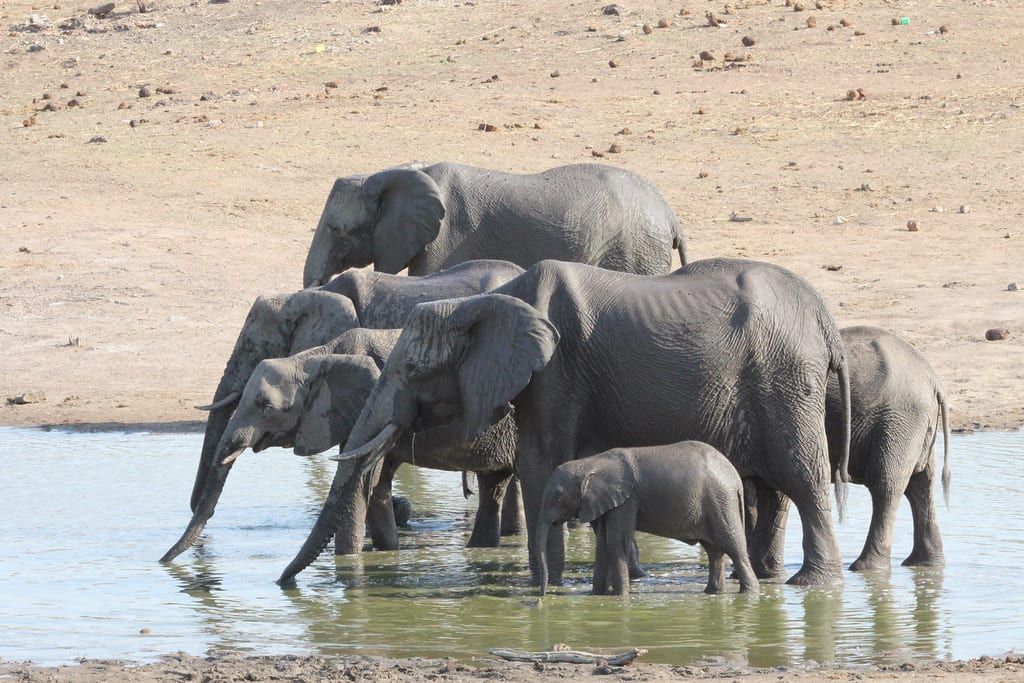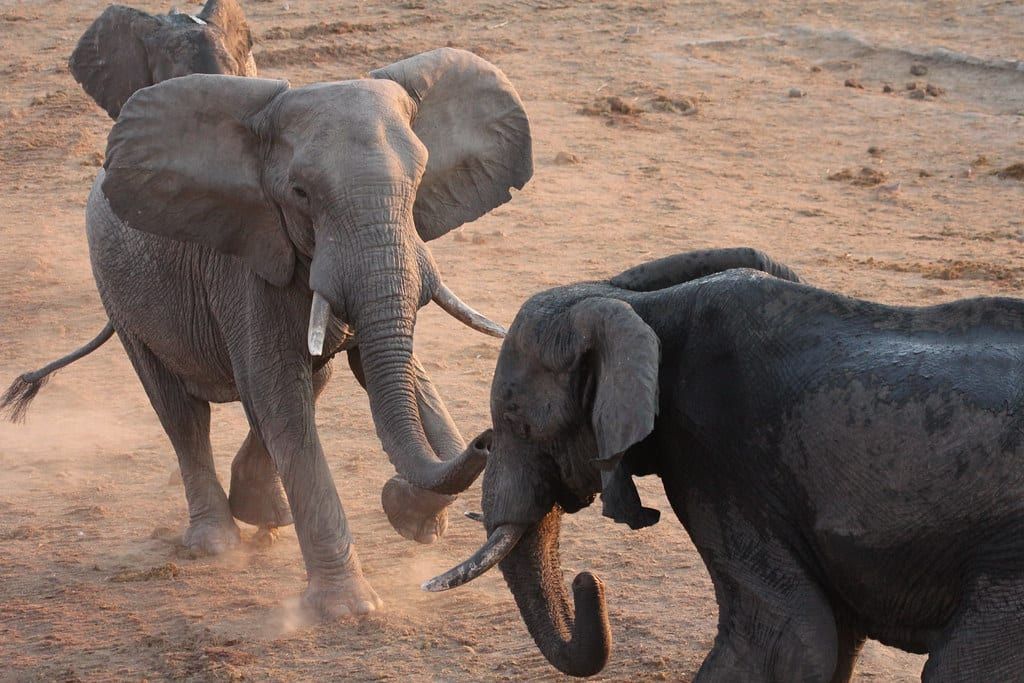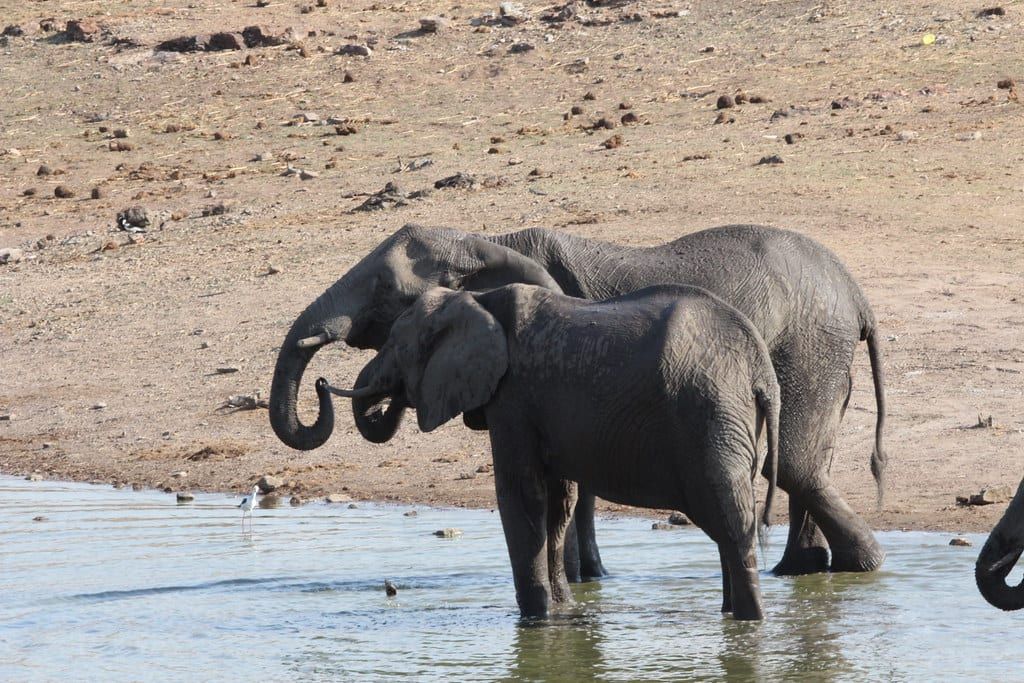
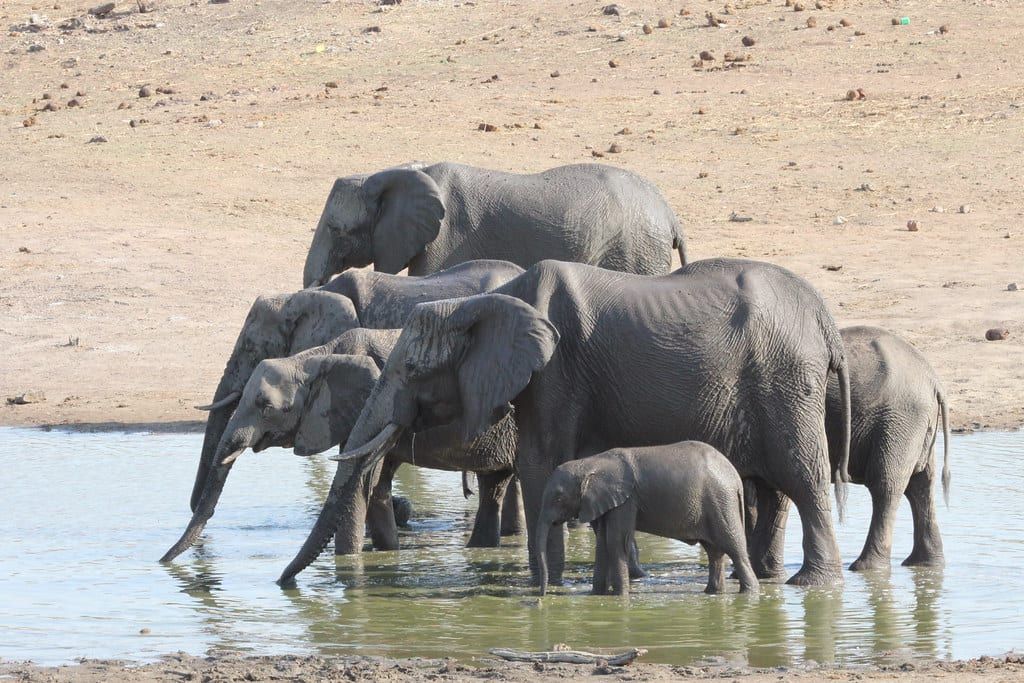
Roughly 45,000 elephants live in Hwange National Park — about 10% of Africa's entire savanna population concentrated into one corner of north-west Zimbabwe. In the dry season, hundreds at a time crowd the park's pumped waterholes, close enough that you can hear them drink. Nothing else in African safaris looks quite like it.
This guide covers the numbers and the story behind them, then gets practical: when to come, which pans to sit at, where to sleep, and how a Hwange elephant trip fits with Victoria Falls.
Hwange's Elephants at a Glance
About 45,000 elephants roam Hwange, out of roughly 83,000 in Zimbabwe as a whole — the second-largest national elephant population on earth. Within the five-nation Kavango-Zambezi (KAZA) Transfrontier Conservation Area, which Hwange joined in 2011, only Botswana's Chobe ecosystem holds more. Numbers you'll see quoted range from 40,000 to 50,000, and the spread is real rather than sloppy counting: the herds drift back and forth across the Botswana border, so a census depends on the season and the survey method.
The park itself is Zimbabwe's largest protected area, 14,651 km² of Kalahari sand, teak and mopane woodland and grassland between Victoria Falls and Bulawayo. Over 100 mammal species and nearly 400 bird species share it — lions in prides of up to 20, leopards, buffalo, sable, cheetah, and one of Africa's largest surviving African wild dog populations, most visible at dens between June and August. The predators follow the elephants' schedule too: where hundreds of pachyderms gather to drink, everything else gathers with them.
What makes Hwange different from most elephant parks is the viewing geometry. There's no riverfront like Chobe's and no open floodplain like the Okavango. Instead you sit at a waterhole — on a raised platform, in a hide at eye level, or from your vehicle a few metres back — and the elephants come to you. It's theatre rather than chase, and it rewards patience over mileage.
Why Hwange Has So Many Elephants
The headline number is a human artefact. Hwange sits on deep Kalahari sand with no permanent rivers and, in a normal year, almost no surface water that lasts through the dry months. When the area was declared Wankie Game Reserve in 1928, it held perhaps 2,000 elephants — the land simply couldn't support many more in the dry season.
That changed with the first warden, Ted Davidson. In the early 1930s he began pumping groundwater into artificial pans so wildlife could survive the dry months, and the practice never stopped: today a network of boreholes, maintained by ZimParks with support from NGOs, keeps dozens of waterholes running year after year. The pumps removed the bottleneck that capped the population. Add decades of anti-poaching effort and, since 2015, a mandatory nine-year prison sentence for elephant poaching, and the herds grew from 2,000 to today's 45,000.
The elephants still keep the old rhythms. GPS tracking shows they visit the pumped waterholes roughly every other day through the dry season, then abandon them almost entirely when the rains arrive between October and December — the natural pans refill and the herds spread out, with many crossing west into Botswana. Hwange's elephants and Botswana's are one shared population that happens to straddle a border. If you arrive fresh after good rains and wonder where everyone went, that's why. The herds also shape the park for everyone else: they dig seep wells that other animals drink from, keep paths open through the woodland, and browse the bush into the open grassland that grazing species depend on.
Best Time to See Elephants in Hwange
Water, not weather, drives the calendar here. The drier it gets, the fewer drinking places remain, and the bigger the crowds at the ones that do — so viewing improves week by week as the dry season grinds on. From June to October, herds of up to 100 elephants gather at a single pumped pan, and in September and October hundreds can mass at one waterhole in the midday heat.
| Window | Typical temperatures | What to expect |
|---|---|---|
| May–July | 7–27°C | Cool mornings, thinning bush, building waterhole action, fewer visitors |
| August–October | 13–38°C, over 40°C possible | Peak gatherings — herds of 100+ per pan, dust and heat, busiest camps |
| November–April | 16–35°C | Lush scenery, newborns, migrant birds — but herds disperse to Botswana and sightings thin out |
August through October is the spectacle. Vegetation is at its thinnest, photography is superb, and the pans are standing room only. The trade-off is heat: October regularly tops 38°C and can pass 40°C, and everything is coated in dust. July is the compromise month — cooler, cheaper and already productive. Come in the green season for scenery, baby elephants and roughly 400 bird species including migrants, but understand that many of the herds will be in Botswana, not here. Our month-by-month guide to the best time to visit Hwange has the detail if you're weighing a specific date.
Where to See Elephants: The Best Waterholes and Pans
Hwange's tourism is organised around three sections — Main Camp in the north-east, Sinamatella in the north, and Robins in the west — and the most famous waterholes cluster around Main Camp and on the central Linkwasha and Ngamo plains. Within that, a handful of pans earn their reputation every dry season.
Nyamandhlovu Pan
One of the park's oldest and best-known waterholes, with a raised wooden viewing platform that photographers rate among the best in Zimbabwe. It sits in the Main Camp area, reachable on a normal sedan's roads, and in peak season you can watch successive herds trade places at the water for hours without moving your vehicle.
Ngweshla Pan
The record-setter: more than 1,000 elephants came to drink and wallow here in a single 24-hour period during one dry season. Ngweshla lies in the Linkwasha area and has its own picnic site, so you can overnight beside the pan and catch the dawn and dusk sessions without driving anywhere.
Masuma Dam and Guvalala Pan
Masuma's thatched hide sits right at the water's edge, giving close, low-angle sightings of elephants plus hippo, lion and the occasional leopard. It also has an overnight picnic site, which means you can be in position before the day traffic arrives. Guvalala, to its south, has a raised hide on a busy wildlife route — less famous, often quieter, and a good fallback when the big-name pans have vehicles queued.
Deteema Dam and the Nehimba seeps
Up in the Sinamatella area, Deteema Dam draws regular elephant herds with far fewer vehicles than the Main Camp circuit — a good choice in August and September when you want big numbers without the audience. The Nehimba seeps, where groundwater reaches the surface naturally, attract elephants that dig and wallow in the wet ground; Nehimba Safari Lodge sits on them.
Strategy matters more than mileage. Since herds drink roughly every other day and mostly come in early morning and late afternoon, pick a pan, get there before the light does, and stay put — the classic mistake is racing between waterholes and arriving at each one just after the elephants have left. Guided drives earn their fee here: a good guide knows which pans were busy yesterday and therefore which are due a visit today. Our Hwange safari guide covers the practicalities of drives and routes.
Experiencing the Herds: Drives, Hides, Walks and Night Drives
Game drives at dawn and dusk are the default, and in Hwange they double as waterhole shuttles — the driver's job is less about finding elephants than about timing your arrival at the right pan. Self-drivers do this well on the Main Camp loops; deeper into the park you'll want a high-clearance 4WD and a good sense of which roads survive the season.
The hides are what make the place. Sitting at eye level a few metres from drinking elephants, with the engine off and your voice down, you get herd behaviour rather than sightings — the matriarch's arrival, the calves barging in, the queue discipline at the water's edge. Photography etiquette is simple: no sudden movement, no standing up in open vehicles, and never block an elephant's path to the water. ZimParks specifically warns about herds with calves; give breeding herds wide berth and reverse slowly if one mock-charges.
Walking safaris are a Hwange speciality. Zimbabwe's licensed professional guides pass through one of the continent's hardest training and licensing systems, and a walk with one is less about seeing elephants than about reading them — fresh tracks, dung age, wind direction, and how to back away from a herd you never intended to meet. All walks inside the park are done with armed guides arranged through lodges. Night drives are the concession perk: they're only permitted on the private concessions bordering the park, not inside it, and they add brown hyena, bat-eared fox and springhare to the list.
Calibrate expectations on the Big Five: Hwange has four of five, with elephant in overwhelming numbers plus lion, leopard and buffalo all regularly seen. Rhino are effectively extinct here. Come for the elephants, the predators and the wild dogs rather than a checklist. If comparing guided options is part of your planning, our Hwange safari tours page lists trips built around exactly this.
Staying Close to the Herds: Where to Sleep Among the Elephants
The smartest elephant trips are built around accommodation, because a camp with its own productive waterhole delivers viewing you'd otherwise drive hours for. Five stand out.
The Hide Safari Camp overlooks an active waterhole with an eye-level hide plus an upper platform right at the water — elephants drink metres from your dinner table, and the camp's single-level decking and ramps make it the park's most accessible lodge. Somalisa Camp has elephants that regularly drink at the camp pool's edge, and guests can sleep out in one of the hides. Camp Hwange overlooks a perennial waterhole and is run by one of Zimbabwe's leading professional guides, with a team known for deep elephant-behaviour knowledge — the pick if understanding what you're watching matters as much as watching it.
Nehimba Safari Lodge sits on a year-round waterhole in the north-west where elephants have been known to drink from the lodge pool itself; its seeps make it a dry-season magnet. Jozibanini Camp, in the remote south-west, is the wilderness option — an underground hide at a pumped pan and mountain-biking along well-worn elephant trails. There's also a self-drive route: ZimParks runs simple chalets and campsites at Main Camp, Sinamatella and Robins, and picnic sites at Ngweshla, Masuma and Deteema put you inside the pans overnight. Our guide to Hwange accommodation breaks down the full range.
Park versus concession is the real decision. Inside the park you get the famous pans, the hides and the lower ZimParks tariffs (US$12 per night for accommodated international guests, versus US$24 as a day visitor). On a private concession you get night drives, walks straight from camp, off-road driving and far fewer vehicles. Photographers and families often split the difference: two nights at a waterhole camp, two at a concession lodge.
The Elephant Paradox: Water, Drought and the Future of the Herds
The waterholes that make Hwange's spectacle possible are also its central ecological argument. Pumping water into a naturally waterless landscape concentrates tens of thousands of elephants onto ground that would otherwise feed a fraction of them: woodlands get hammered, soils compact, and the herds become dependent on machines and fuel that must be funded every single year. There is no version of Hwange today without the pumps — but there is also no honest account of the park that ignores what they do to the vegetation.
Zimbabwe has wrestled with this for decades. Between 1960 and 1991 the country culled or hunted 46,775 elephants in response to habitat damage, yet the national population still grew from about 30,000 to 76,000 over the same period. Culling stopped in 1991. ZimParks now publicly describes the country's elephants as overpopulated and has floated a new culling programme, which conservation groups contest — the debate is unresolved and worth knowing about before you visit.
Then there is the climate. In December 2023 an El Niño dry spell killed dozens of Hwange elephants — they died of thirst as waterholes dried up weeks before the rains arrived. Across the 2023–24 season, Main Camp recorded only about 360 mm of rain against a far higher long-term norm, and more than 100 elephants died, most of them calves and old animals. The event was a warning about how quickly the system fails when rains and pumps fall short together.
Keeping the water flowing is a permanent funding scramble. ZimParks runs the park; IFAW supports its capacity in Hwange; the Bhejane Trust maintains borehole pumps; the Conservation & Wildlife Fund and Painted Dog Conservation work on research, anti-poaching and community programmes. Your visit is part of the economics — conservation fees, lodge levies and tourist dollars are what keep diesel in the pumps and rangers in the field, so choosing a camp that publishes its conservation contributions is the single most useful thing an elephant-focused traveller can do here.
Planning Your Hwange Elephant Safari
Most visitors arrive from Victoria Falls: about 200 km on a surfaced road, roughly three hours to the Main Gate and Main Camp, with road transfers easy to arrange and day trips possible but rushed — three hours each way means missing the dawn and dusk sessions entirely. Charter flights land at Main Camp or Robins airstrips in 25 to 60 minutes, requiring prior permission for Main Camp. There are no scheduled flights into the park; see our directions guide for the full breakdown, including the Bulawayo route and the overnight train.
Stay three nights, ideally at a camp with its own waterhole. Two is the practical minimum given the park's size and the every-other-day drinking rhythm — one night is a drive-by that gambles on the wrong half of the cycle. Book several months ahead for August to October; the waterhole-front lodges and the Ngweshla and Masuma picnic sites go first. Pairing with Victoria Falls is the natural shape of the trip: falls first, then two or three nights among the elephants, all inside a week. Our tours from Victoria Falls page lists options that do exactly this.
| Hwange | Chobe | |
|---|---|---|
| Dry-season herds | Around 45,000 | An estimated 50,000 |
| Viewing style | Waterhole hides and platforms, walking safaris, night drives on concessions | River boats and drives along the Chobe riverfront |
| Crowds | Few vehicles, especially away from Main Camp | Riverfront gets busy at peak times |
| Typical cost | Usually lower, strong self-drive options | Higher, premium river lodges |
| Best for | Immersive, unhurried elephant watching | Big numbers with easy logistics |
So which one? If you want guaranteed elephant abundance with minimal effort, Chobe's boats deliver it. If you want to sit alone at a hide while a hundred elephants come to you, walk to them with a professional guide, and pay less for it, Hwange wins — and its herds are the same animals. Longer trips can take in both, plus Mana Pools or the Okavango. We go deeper in our Hwange vs Chobe comparison, and if you're weighing South Africa too, the Hwange vs Kruger piece covers that angle.
Frequently asked questions
How many elephants are in Hwange National Park?
Around 45,000, with estimates ranging from 40,000 to 50,000 depending on season and survey method. That is out of roughly 83,000 elephants in Zimbabwe — the world's second-largest national population — and the second-largest herd in the KAZA transfrontier area. The variation exists because the herds move between Hwange and Botswana as one shared population.
When is the best time to see elephants in Hwange?
June to October, with August to October the peak. As natural water dries up, wildlife crowds the pumped waterholes and herds of 100 or more gather at single pans; in September and October, hundreds can mass at one waterhole at midday. Expect 38°C and more in October, so travellers who want cooler mornings should target May to July.
Why does Hwange have so many elephants?
The park has no permanent surface water, so from the 1930s wardens began pumping boreholes into artificial waterholes — a network still maintained today. That removed the dry-season bottleneck, and with anti-poaching protection the population grew from roughly 2,000 at the 1928 game reserve declaration to about 45,000 now.
Where are the best places to see elephants in Hwange?
Nyamandhlovu Pan (raised viewing platform), Ngweshla Pan (more than 1,000 elephants recorded in 24 hours), the Masuma and Guvalala hides, Deteema Dam and the Nehimba seeps. The Main Camp area and the Linkwasha and Ngamo plains hold the most famous waterholes; the Ngweshla, Masuma and Deteema picnic sites let you sleep beside them.
Do Hwange's elephants migrate out of the park?
Partly. When the rains arrive between October and December, GPS tracking shows the elephants abandon the pumped waterholes, and many disperse west into Botswana, returning as the dry season progresses. Hwange's and Botswana's herds are effectively one cross-border population.
Is Hwange or Chobe better for seeing elephants?
Both hold enormous herds — roughly 45,000 in Hwange against an estimated 50,000 in Chobe in the dry season. Chobe offers boat-based viewing on the river but a busy riverfront; Hwange offers waterhole hides, walking safaris, far fewer vehicles and typically lower cost. For immersion, Hwange; for effortless abundance, Chobe.
Does Hwange have the Big Five?
Four of five: elephant, lion, leopard and buffalo are all regularly seen, but rhino are effectively extinct in the park. Frame Hwange as an elephant, predator and wild dog destination rather than a Big Five tick-list park.
How are Hwange's elephants protected — and are they in danger?
ZimParks manages the park with support from IFAW, the Bhejane Trust (borehole pump maintenance) and the Conservation & Wildlife Fund, and elephant poaching now carries a mandatory nine-year sentence. The bigger threat is climate: in the 2023–24 El Niño drought, waterholes dried early and over 100 elephants died, mostly calves and old animals.
Sources
- zimparks.org.zw/hwange-national-park
- zimparks.org.zw/media/2024/07/Hwange-GMP.pdf
- zimparks.org.zw/wp-content/uploads/2024/05/Zimbabwe-Elephant-Management-Plan-FIN
- zimparks.org.zw/media/2026/02/De-Gazetted-Tariff-2026.pdf
- ifaw.org/resources/conservation-hwange-zimbabwe-factsheet
- cms.int/sites/default/files/publication/Fact%20Sheet%20on%20African%20Elephant%2
- wwf.panda.org/es?329360%2FIntegrated-approach-to-elephant-conservation-in-Zimbab
- reuters.com/business/environment/dozens-zimbabwe-elephants-die-climate-change-dr
- aljazeera.com/features/2021/6/5/zimbabwe-elephant-culling-plan-stirs-debate
- conservationfrontlines.org/2020/04/elephants-a-crisis-of-too-many-not-too-few
- en.wikipedia.org/wiki/Hwange_National_Park